
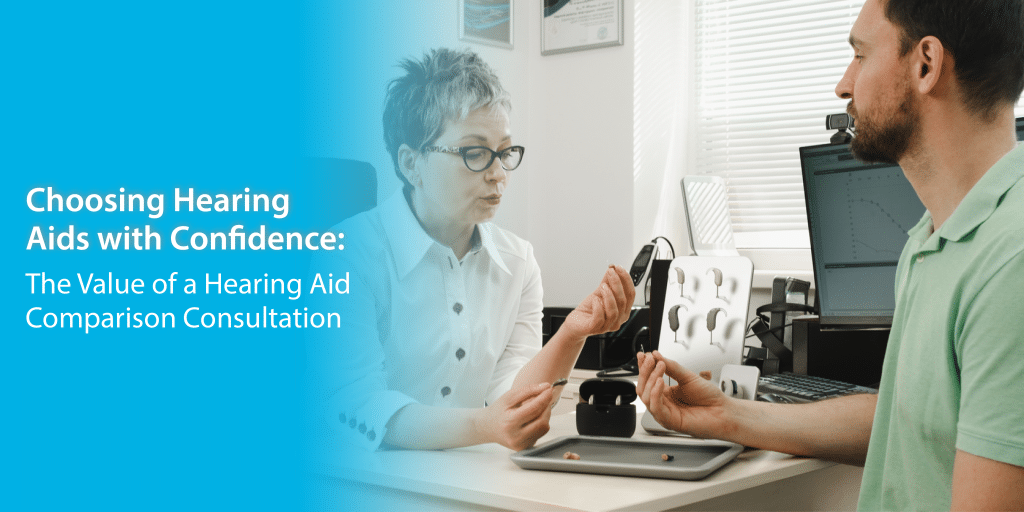
In Ottawa and the surrounding region, patients increasingly ask whether they can compare hearing aid brands before committing to a device.
Summary:
A Hearing Aid Comparison Consultation allows patients to hear differences between leading hearing aid technologies before making a decision. This article explains how the process works, why hearing is not one-size-fits-all, and who may benefit from guided comparison. Readers will gain clarity on how experiential listening can support confident, informed choices.
Key Highlights:
- Explains how hearing aid comparison supports informed decision making
- Describes differences between hearing aid sound processing technologies
- Clarifies why hearing is personal and not one size fits all
- Outlines when guided listening may improve confidence and satisfaction
- Highlights how experiential listening reduces uncertainty before purchase
Author name: Karine Bossé, Owner & Head Audiologist
Author Bio: Karine Bossé, M.Sc.S., Aud (C), Reg. CASLPO is the Owner and Head Audiologist at Echo Audiology in Orléans, Ontario. She holds a Master’s Degree in Audiology from the University of Ottawa and is certified in both Canada and New Zealand. A multi-year recipient of The Ottawa Awards for Best Hearing Specialist, Karine is known for her calm, approachable style and her ability to clearly explain complex hearing information while supporting patients with compassion and confidence.
Why Choosing Hearing Aids Can Feel Overwhelming
If you have recently been told you may benefit from hearing aids, or if you are considering upgrading your current devices, you are not alone in feeling uncertain.
Many patients describe the process as overwhelming. Today’s hearing technology landscape includes:
- Multiple brands
- Numerous technology levels
- Confusing feature lists
- Online reviews that contradict each other
- Advice from friends and family with very different experiences
Even after a professional hearing assessment and thoughtful recommendation, it is natural to wonder:
- How do I know this is the right choice?
- What if another option would sound better?
- Will I regret my decision later?
Hearing technology today is highly advanced, but with more options comes more complexity. This blog is designed to help you understand one optional tool that can support decision-making: a Hearing Aid Comparison Consultation.
What Is a Hearing Aid Comparison Consultation?
A Hearing Aid Comparison Consultation is a structured, in-clinic listening session designed to help patients hear differences between hearing aid technologies before finalizing their choice.
Rather than relying only on brochures, feature lists, or brand names, patients participate in guided listening exercises that allow them to experience how different sound processing systems perform.
At Echo Audiology, this consultation uses a patented comparison application called Earscript, which allows patients to:
- Listen to speech in quiet environments
- Hear speech in background noise
- Compare how different technologies manage complex listening situations
- Notice differences in clarity, sharpness, comfort, and listening effort
Importantly, this is a clinician-guided session. You are not left alone to “figure it out.” A qualified hearing professional walks you through what you are hearing and helps interpret subtle differences.
Family members are welcome to attend, which often helps loved ones better understand what the patient is experiencing.
A Hearing Aid Comparison Consultation is designed to complement — not replace — a comprehensive hearing assessment and individualized programming. It builds on professional recommendations by giving patients the opportunity to experience differences firsthand.
The Common Misconception: “A Hearing Aid Is a Hearing Aid”
A common assumption is that hearing aids are mostly the same, and that differences come down to brand preference or price. Hearing aid selection is not about assuming which brand is best, it is about understanding how sound is experienced by you. Hearing aid fitting at Echo Audiology follows evidence-based best practices, including verification through Real Ear Measurements (REM). REM ensures that amplification levels precisely match your prescribed targets based on your individual hearing profile. This objective validation process is considered the gold standard in modern audiology and supports optimal clarity, comfort, and long-term satisfaction.
In reality, hearing aids differ in meaningful ways, including:
- How they process speech
- How they reduce background noise
- How they manage sudden loud sounds
- How they adapt automatically to environments
- How directional microphones function
- How sound is shaped for different hearing profiles
Even within one brand, devices can be configured in multiple ways depending on:
- The degree and configuration of hearing changes
- The shape and size of the ear canal
- Power requirements
- Use of domes versus custom earmolds
- Personal comfort preferences
Two individuals with similar hearing test results may describe very different listening experiences with the same device.
After a hearing aid is selected, it is programmed specifically for your hearing profile. At Echo Audiology, Real Ear Measurements are used to validate programming accuracy, and further adjustments are made based on your subjective experience.
This means the final result is individualized. However, before reaching that stage, some patients find it helpful to better understand how different sound philosophies feel.
Why Hearing Aid Comparison Is Often Missing from the Process
Traditionally, the hearing aid process follows this pathway:
- Clinical recommendation
- Device fitting
- Follow-up adjustments during the trial period
This model has served patients well for many years and continues to be effective.
However, structured side-by-side listening tools are not widely available in many communities. Many clinics do not offer a formalized comparison experience.
For that reason, some patients may not realize this type of guided listening session exists.
For those who prefer a more hands-on, experiential approach, structured comparison can provide additional clarity.
The Limits of Brochures, Online Research, and Specifications
Modern hearing aids include advanced features such as:
- Artificial intelligence-based sound processing
- Adaptive noise reduction
- Bluetooth connectivity
- Rechargeable technology
- Wind noise management
- Automatic environment detection
While these features are valuable, reading about them does not always translate into understanding how they will sound in your daily life.
Online research can also increase confusion. Comparison charts may list features but rarely explain:
- How programming is customized
- How fitting formulas influence sound
- How your ear anatomy affects performance
- How real-world environments differ from controlled testing environments
In addition, hearing professionals who work closely with multiple manufacturers gain insight that is not typically published online. This includes long-term reliability trends, patient feedback patterns, and software flexibility.
Hearing is not theoretical; it is perceptual. That is why some patients benefit from experiencing differences rather than simply reading about them.
Why There Is No Universally “Best” Hearing Aid
One of the most common questions patients ask is:
“Which hearing aid brand is the best?”
It is an understandable question. With so many manufacturers and technology levels available, it may seem logical that one brand must stand above the rest.
The honest answer, however, is that there is no single “best” hearing aid for everyone.
Every person’s hearing is unique. Listening experience is influenced by multiple factors, including:
- The type and configuration of hearing changes
- Speech discrimination ability
- Tolerance for loud sounds
- Sensitivity to background noise
- Cognitive listening effort
- Daily listening environments
For example:
- Someone who attends frequent family gatherings may prioritize speech clarity in noise.
- Someone working in an office may prioritize focus during meetings.
- Someone retired may prioritize comfort, ease of use, and simplicity.
In addition to individual hearing differences, manufacturers use distinct sound processing philosophies, algorithms, and adaptive technologies. While many leading brands produce high-quality devices, the way they manage speech, background noise, and environmental transitions can feel noticeably different from one person to another.
The “best” hearing aid, therefore, is not determined by brand popularity or marketing claims. It is determined by how well a device aligns with your hearing profile, listening environments, and personal sound preferences.
A Hearing Aid Comparison Consultation can support this individualized approach. By experiencing how different sound processing systems perform in structured listening situations, patients can better identify what feels most natural and comfortable to them.
This personalized process supports long-term satisfaction and reduces the likelihood of second-guessing after a decision has been made.
How Hearing Aid Comparison Can Support Confidence
One of the most common concerns patients express is fear of making the wrong choice.
A guided comparison session can help reduce:
- Second-guessing
- Anxiety about brand selection
- Worry about missing out on better performance
- Feeling rushed into a decision
When patients hear differences firsthand, they often feel:
- More informed
- More involved in the process
- More confident in their final choice
At Echo Audiology, clinicians remain confident in their prescription recommendations. The comparison consultation is designed to help patients feel equally confident through personal listening experience.
Since introducing this consultation, we have observed that many patients appreciate the opportunity to hear differences in a structured setting.
“I’ve had the opportunity to conduct several hearing aid comparison consultations already through this app, and it’s been incredibly rewarding to see how much our patients benefit from hearing the differences between hearing aid brands firsthand. While we’ve always been confident in the hearing aids we prescribe, this tool adds an extra layer of confidence for patients by allowing them to validate their choice through their own listening experience. Feedback has been incredibly positive, with patients and their families finding the experience both informative and eye-opening. We’re excited to see how this tool continues to empower patients in making informed decisions about their hearing aids.”
– Danielle Grundy, M.Mus., HIS, Reg. AHIP
Reducing “What If?” After Purchase
It is normal to question a healthcare decision after making it.
Some clinics offer short two-week trials. At Echo Audiology, patients have a 75-day trial period after purchasing, allowing over two months to adapt to new sound and request adjustments.
The Hearing Aid Comparison Consultation can be helpful:
- Before purchasing hearing aids
- During the trial period if challenges arise
- When exchanging devices
- When renewing hearing aids
- When a patient is dissatisfied with current hearing aids
If a patient cannot hear significant differences between brands, that information is still clinically valuable. It may broaden suitable options or guide programming adjustments.
In some cases, understanding a patient’s listening preference during comparison allows clinicians to adjust programming to better reflect another manufacturer’s sound processing philosophy.
The goal is long-term satisfaction.
Who May Benefit Most from a Hearing Aid Comparison Consultation?
While not required for everyone, comparison consultations may be particularly helpful for:
- First-time hearing aid users
- Individuals who feel overwhelmed by options
- Patients who want reassurance before committing
- Families involved in the decision-making process
- Individuals unhappy with their current hearing aids
- Patients renewing or upgrading devices
It is also important to note that not every ear can clearly perceive differences between technologies. If this occurs, it simply provides additional information to guide the fitting process.
Access to Hearing Aid Comparison in Ottawa
Structured hearing aid comparison using platforms such as Earscript is still not widely available throughout the Ottawa and surrounding Eastern Ontario region. Echo Audiology currently offers this formalized listening experience as part of its commitment to transparent, patient-centered care.
This service is positioned as an educational and supportive resource, not a required step and not a replacement for professional assessment.
Its purpose is to provide:
- Transparency
- Education
- Shared decision-making
- Increased patient confidence
Confidence Comes from Understanding
Choosing hearing aids is a significant decision. It affects communication, relationships, independence, and daily quality of life.
Professional recommendations are based on clinical training, experience, and careful assessment. For some patients, confidence deepens when they can hear differences for themselves.
A Hearing Aid Comparison Consultation is one optional tool designed to make the process more transparent and patient-centered.
If you are in Ottawa, Orléans, or surrounding East Ottawa communities and are considering hearing aids for the first time, renewing your devices, or feeling uncertain about your current technology, speaking with a qualified hearing professional about whether a comparison consultation may benefit you can be a helpful next step.
At Echo Audiology, the goal is not simply to provide hearing aids, but to support informed, confident decisions that align with your individual needs.
To learn more or to schedule a consultation, contact Echo Audiology today. Our team is here to provide clear guidance, answer your questions, and support you in making an informed choice that fits your hearing needs and lifestyle.
Frequently Asked Questions
What is a hearing aid comparison consultation?
A hearing aid comparison consultation is a structured, clinician-guided listening session that allows patients to hear differences between mainstream hearing aid technologies before choosing a device. Using tools such as Earscript, patients compare speech clarity, background noise management, and overall sound quality to better understand which option aligns with their hearing profile.
Is a hearing aid comparison consultation necessary for everyone?
No. Many patients feel comfortable proceeding based on a professional recommendation after their hearing assessment. A hearing aid comparison consultation is an optional educational tool for individuals who prefer to experience sound differences firsthand before finalizing their decision.
Can everyone hear differences between hearing aid brands?
Not always. Some individuals clearly perceive variations in sound processing, while others may notice minimal differences. If differences are not easily perceived, that information is still clinically useful and can help guide programming adjustments or broaden suitable hearing aid options.
Does comparison replace professional hearing aid fitting?
No. A hearing aid comparison consultation does not replace a comprehensive hearing assessment or individualized programming. Final fitting includes customized adjustments and validation measures, such as Real Ear Measurements, to ensure amplification matches your specific hearing needs.
When is a hearing aid comparison consultation most helpful?
This type of consultation may be helpful for first-time hearing aid users, individuals renewing devices, or those dissatisfied with current technology. It can also support patients who feel overwhelmed by options and want additional clarity before making a long-term decision.
How long does a hearing aid comparison consultation take?
Most comparison consultations take approximately 45 to 60 minutes. The session includes guided listening exercises and discussion with your hearing professional to interpret what you are hearing and answer questions.
Can I bring a family member to my hearing aid comparison consultation?
Yes. Family members are welcome to attend. Having a loved one present can provide additional support and help them better understand your listening experience and decision-making process.


